Monday, 6 January 2014

Ad Reinhardt

Jacqueline Baas, Smile of the Buddha: Eastern Philosophy and Western Art
(University of California Press, 2005)

Member of American Abstract Artists Group 1937-47, did a master's in Asian art history. Critical of abstract expressionists - antithesis of what would be called art in far east, where intensity and consciousness are based on repetition and tradition.
Often described as monk-like in his way of living.  Zen practitioner.
Gradually eliminated imagery in his art - evolved through calligraphic and brick-like forms to a cruciform of subtly varied shades of one colour - red, blue and then black. Trying to avoid any expression of ego.  Looking for a kind of purity.
His paintings to take time to absorb and to be absorbed by.  One critic wrote that they reduced the viewer 'to the sole organ of his or her vision....What one then perceives, in the blackest of the 'black' paintings, is no longer the infinitesimal variation of color, but the always fleeting, always dubitable, beginning, the promise of a speck of light, the 'last vestige of brightness' ' (Yve-Alain Blois)  The painting as a moment in a process of consciousness.
A lot of theorising e.g. in his Twelve Rules for a New Academy 1953 - very connected to Buddhist teachings on emptiness/nothingness
https://users.wfu.edu/~laugh/painting2/reinhardt.pdf


Abstract painting, Blue 1952


Isamu Noguchi

Jacqueline Baas, Smile of the Buddha: Eastern Philosophy and Western Art
(University of California Press, 2005)

Having trained under Brancusi, initially worked with stone.  Influence of Japanese Zen gardens:
"In Japan the rocks in a garden are so planted as to suggest a protuberance from the primordial mass below...We are made aware of this floating world through consciousness of sheer invisible mass." 
We see the stone and sense what is invisible - both are part of the work.
Saw himself as interpreting the East to the West through sculpture.
Moved to Kyoto, started to work in clay, but saw an art that was beyond made objects and in a way of life.
Concept of sculpture evolving into a relationship of form and space that illuminates the environment in which we live.
Started to work with light.


Developed paper lanterns, akari, for general sale.  'The ideal of akari is exemplified with lightness (as essence) and light (for awareness). . . the quality is poetic, ephemeral, and tentative.'  His father had written a poem ending with the line 'Alas, my soul is like a paper lantern in the rainy world.'
Still working in stone - forms influenced by Buddhist iconography (zen circle, lotus).
In the year before he died he wrote: 'I don't think that art comes from art.  A lot of artists apparently think so. I think it comes from the awakening person.'

Nine Floating Fountains, 1970


Sunday, 5 January 2014

John Cage


Every Day is a Good Day: the Visual Art of John Cage
(Hayward Publishing 2010)

Where R=Ryoanji, drypoint etching 1988
His visual art-making integrated with composing, writing, performance, Zen practic
Use of 'chance operations' (using I Ching) downplayed the role of the self and displaced creativity and choice on to the questions he asked and away from outcomes.  They were a way of stopping wilfulness and anxiety from interfering in the process; 'the person is being disciplined, not the self.'  Led to solutions he might not normally consider. Able to delight in them more freely.

Did not resonate with the abstract expressionists. 'I wanted to change my way of seeing, not my feeling.'  

He had 10 words that acted like guideposts in his methodology: method, structure, intention, discipline, notation, indeterminacy, interpenetration, imitation, devotion and circumstances.

Wanted to create work that wasn't showy, that needed the viewer to pay close attention to it.

Ongoingly experimental including with technology.

John_Cage_Image_ENINKA
Eninka 28, 1983

Had a lifelong small-scale practice of drawing and etching around stones, 'a form of meditation'.

Ryoanji 17, 1988

'Art is a way of life. . . Art when it is art as Satie lived it and made it is not separate from life (nor is dishwashing, when it is done in this spirit.'
'The attitude I take is that everyday life is more interesting than forms of celebration, when we become aware of it. That when is when our intentions go down to zero. Then suddenly you notice the world is magical.'
'I found through Oriental philosophy, my work with Suzuki, that what we are doing is living, and that we are not moving towards a goal, but are, so to speak, at the goal constantly and changing with it, and that art, if it is going to do anything useful, should open our eyes to this fact.'

Favourite saying Japanese 'nichi nichi kore ko niche' - every day is a good/beautiful day.

Wednesday, 1 January 2014

Shibusa aesthetic

Shibusa - Extracting Beauty
Monty Adkins and Pip Dickens (University of Huddersfield Press, 2012)

This is about the interaction of two contemporary artists, one visual and the other working in sound, with the Japanese aesthetic of shibusa - particularly as found in katagami, stencils traditionally used for kimono design.  Because of my own longstanding work with Japanese textile patterns I wanted to understand the philosophy behind them.

Shibusa has 7 elements:
simplicity - expressing the essence of design elements, to create calm in the viewer; a spare elegance but with sparkle
implicitness - the surface hints at an invisible core or depth of feeling
modesty - a high level of understated craftsmanship
tranquillity
naturalness - spontaneous, intuitive
everydayness - joy in ordinary things
imperfection - e.g. asymmetry, rough surfaces

Overall shibusa objects balance simplicity and complexity, and have a certain 'feel' to them.


(Not to be confused with the better known wabi sabi aesthetic which is more severe and supports the exaggeration of imperfections.)

I found myself resonating with most of these; perhaps my earlier work with cardboard has helped me grow into them.  I wonder if they might provide a more conscious framework for what I'm doing now.  

This website has interesting examples on it of contemporary Japanese design
http://www.studiokotokoto.com/


Friday, 20 December 2013

luminous mind

Brightly shining mind

I need to understand this concept more clearly because I am trying to point towards it in creating luminous works.  It is a phrase used by meditation teachers describing the mind state that meditation can lead to e.g.

'By letting the mind be uncontrived, in its natural state, the gross concepts will cease.  The experience of luminous emptiness will arise.'  (Gotsangpa)

'The consciousness is transparent, radiating and clear, without drowsiness and dullness, and one thinks one understands all phenomena.'  (Karmapa Wangchug Dorje)

I've had some experience of this myself - it's like going into a completely different realm of being and understanding.  But what is it, what is going on?

In an early sutra, the Buddha is said to have stated to his followers: 'Luminous monks is the mind.  And it is defiled by incoming defilements.'  (Anguttara Nikaya)  There has been ongoing disagreement as to the correct interpretation as this, broadly falling into two schools.  One claims that luminous mind is the 'ground of becoming' i.e. a fundamental consciousness out of which all individual mental activity arises.  The other disputes this on the grounds that it implies some kind of essence to our nature which the Buddha always denied, teaching that everything is subject to change; this school of thought sees luminous mind as an underlying 'dynamic continuum'.

Whatever its ontological status, both schools teach that clarity and luminosity of consciousness is obscured ('defiled') both by the clutter of everyday thoughts and, more deeply, by entrenched views and habits - like blue sky covered by clouds.  Various methods are taught to clear away what obscures: primarily different methods of meditation, enquiry and ethical practice.

Complete luminosity equates with nirvana, a free mind that does not clutter a situation with its subjectivity but can respond spontaneously and creatively.

In working with light sources (natural and artificial), in works that are about mind and attention, I can prompt the viewer to connect with some sense (depending on their own level of experience) of luminous mind.


Thursday, 19 December 2013

Bill Viola

interview
with Mary Jane Jacob (ed Jacquelynn Baas and Mary Jane Jacob, Buddha Mind in Contemporary Art, Uni of California Press 2004)

Encountered Buddhism at uni in 60s, then Zen when he went to live in Japan - had a Zen teacher.

'In Japan it was beginning to sink in that perhaps art resides in life itself, that as a practice it derives from the quality of experience, depth of thought, and devotion of the maker, not the virtuosity of the object or the success of its presentation.  Everything else follows from that.  With those words, my life changed.'

Struck by a statement by Ananda K Coomaraswamy: 'all art represents invisible things'

Makes art in awareness of his imperfection: 'The ideal of perfection, shining out there just beyond reach, is the reason why I make art.'

Struck by Zen being about practice, not theory; saw that what he did was an artistic practice - opposed this to the academic language of art as investigation. 'The idea of practice was the key connecting thread that joined my new experience with Buddhism to my life's work as an artist.'

With his father's dying he became more interested in conveying strong emotion, 'the spiritual undercurrents and invisible root systems present under all our everyday actions.' Exploring what was fleeting, what was deep emotion - like an underground river. 'The true reality is situated beyond appearances and material forms.' Led to his videos on Christ's Passion.  Began to realise the spiritual dimension to electronic and digital media:
'Sound and light have one foot in this world and one foot somewhere else. they're not completely "real" in the sense of hard material things.  There's some intangible essence there - a spark, a flicker of living energy, both physical and metaphysical - and this has always fascinated me.'

Explores compressing and expanding time - mirrors what can happen in meditation. Wants to reclaim spacious time from 'time as money' attitude - 'We must take time back into ourselves, to let our consciousness breathe and our cluttered minds be still and silent' 
Catherine's Room 2001


He sees art as having the power to release people from suffering, that it can communicate invisible forces: 'This is . . . the responsibility of those with artistic talent: to bring images into the world that can benefit all sentient beings.'


The Crossing (detail) 1996

Artist like everybody else projects his/her consciousness out into the world.  Works in a deeply unconscious way but the eventual bringing of the work into the world is a conscious one - moving between these two realms, visible and invisible; this is one definition of spiritual.  Draws on language of myth, of poetry and the human heart, core human experiences - we need to connect on this level if we are to survive.

Jan Svankmajer

The inner life of objects
exhibition in the University of Brighton Grand Parade Gallery Nov-Dec 2013

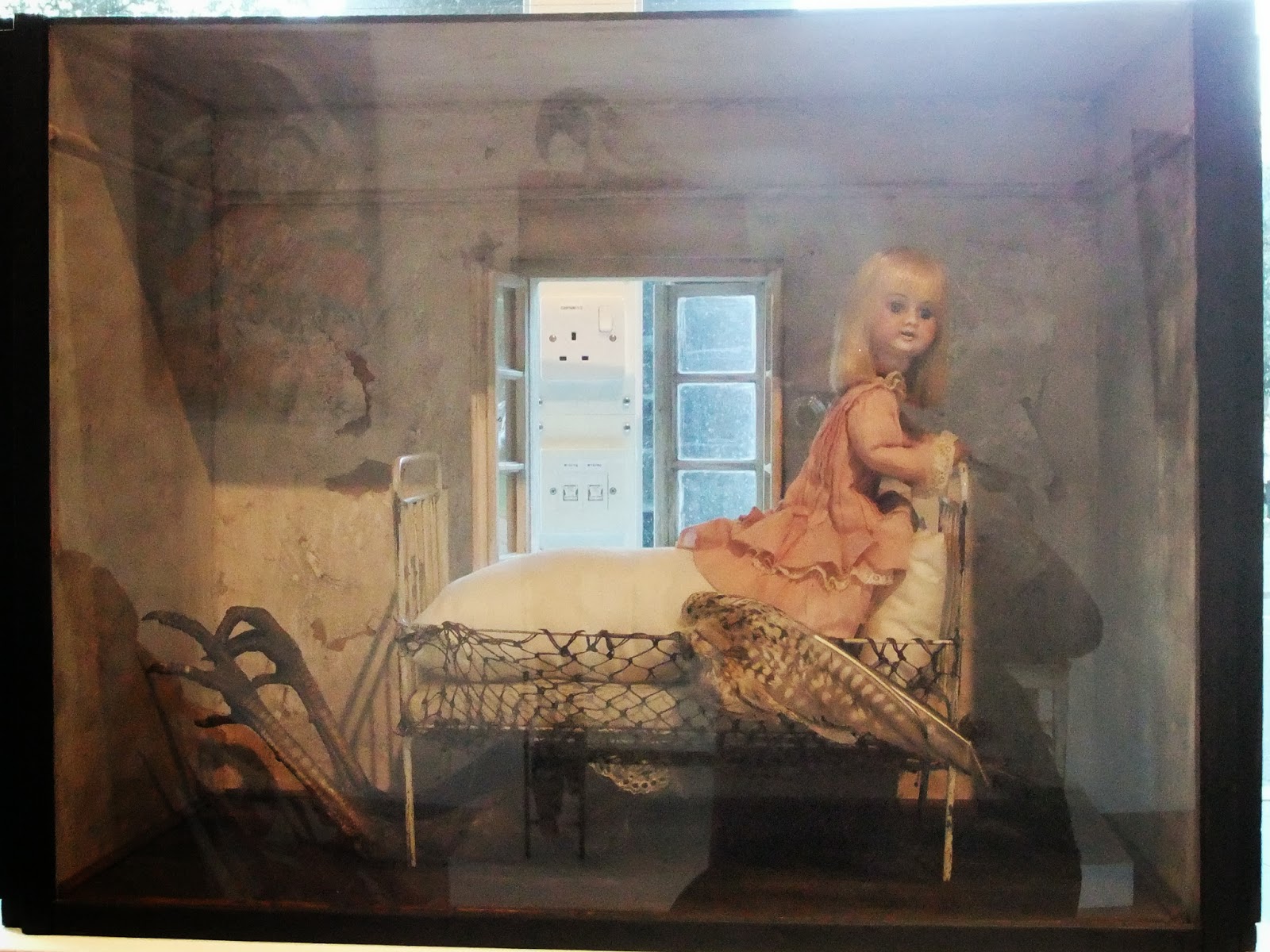
Amongst the surrealist objects and films I was drawn to the miniature stage sets/vitrines, connecting them with the illuminated boxes I want to make. 


What is it about them?  A whole world conveyed in a tiny space, the connection with children's story books and so my own childhood, fear of the unconscious, the attention to detail, the juxtaposition of realistic and fantastical. . . He says something interesting about the latter:


from his Decalogue

The fantastical needs the realistic to be convincing.  So depending on which way I go with mine, that may be useful to bear in mind.